IDDRR Logo
IDDRR - Main navigation
  • Learn
  • Act
  • Share on social
  •  Search
Menu
Author(s) Shouro Dasgupta Elizabeth Robinson

Improving food security and child health in Burkina Faso in a changing climate

Source
London School of Economics and Political Science, the

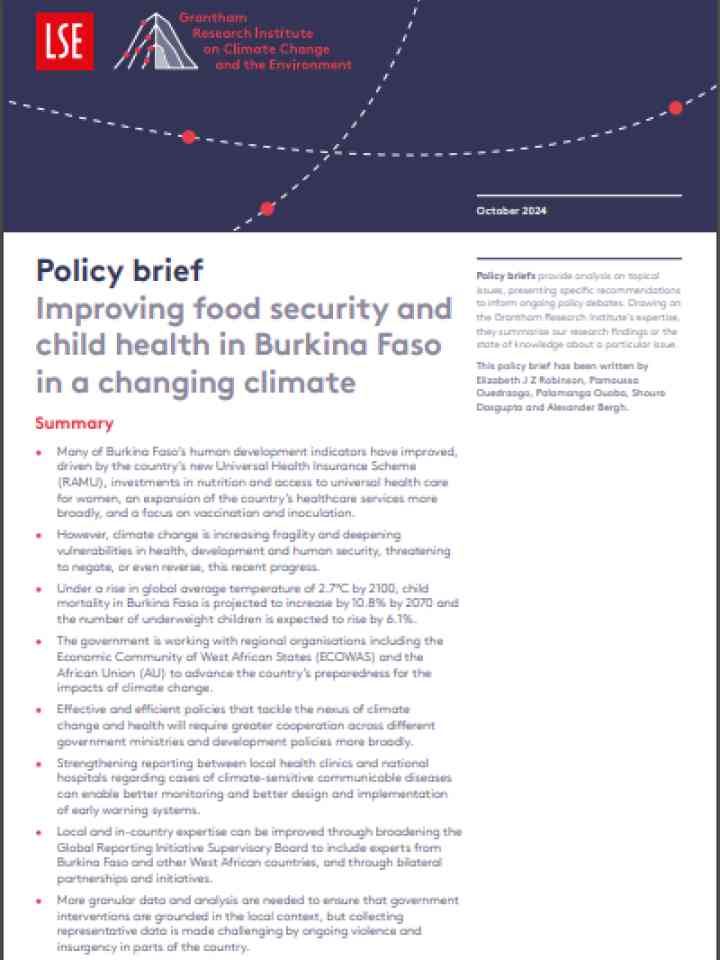
This policy brief highlights priority areas for actionable advances in improving food security, nutrition and child health in Burkina Faso in the context of a changing climate. Burkina Faso is increasingly having to deal with the growing challenges of climate change, which is leading to greater fragility and deepening vulnerabilities, undermining efforts to reduce poverty and increase prosperity.

Some of the key messages from the brief include:

  • Effective and efficient policies that tackle the nexus of climate change and health will require greater cooperation across different government ministries and development policies more broadly.
  • The government is working with regional organisations including the Economic Community of West African States (ECOWAS) and the African Union (AU) to advance the country's preparedness for the impacts of climate change.
  • Many of Burkina Faso's human development indicators have improved, driven by the country's new Universal Health Insurance Scheme (RAMU), investments in nutrition and access to universal health care for women, an expansion of the country's healthcare services more broadly, and a focus on vaccination and inoculation.

Download

Improving food security and child health in Burkina Faso in a changing climate PDF, 0.9 MB English

Last checked: 11 October 2024

Editors' recommendations

  • Climate, weather and child health in Burkina Faso
  • Regional approach to adaptation to climate change in Burkina Faso
  • Financing adaptive social protection in Burkina Faso
  • Burkina Faso: Plan régional d’adaptation au changement climatique 2024-2028

Explore further

Themes Children and Youth Food security and agriculture Health and health facilities
Country and region Burkina Faso
Cover
Number of pages
8 p.
Publication year
2024

Also featured on

PreventionWeb

Is this page useful?

Yes No
Report an issue on this page

Thank you. If you have 2 minutes, we would benefit from additional feedback (link opens in a new window).

The International Day for Disaster Risk Reduction was started in 1989, after a call by the United Nations General Assembly for a day to promote a global culture of risk-awareness and disaster reduction. Held every 13 October, the day celebrates how people and communities around the world are reducing their exposure to disasters and raising awareness about the importance of reining in the risks that they face.

Loading