Niger advances early warnings for all on disaster risk reduction day

Picture of the renovated situation room.
Marking a key moment in Niger’s journey toward universal early warning coverage, the Government of Niger celebrated a major milestone in the acceleration of its Early Warnings for All (EW4ALL) initiative. The official launch of the National EW4ALL Roadmap took place in Niamey on 13 October, during the commemoration of the International Day for Disaster Risk Reduction 2025 under the theme “Fund Resilience, Not Disasters”.
The roadmap underscores the country’s commitment to strengthening disaster risk reduction and resilience through the progressive implementation of a national plan for multi-hazard early warning systems.
“It is out of duty that we tirelessly work to strengthen the instruments, tools, and mechanisms that contribute to building the resilience of our populations and preserving development gains.” Colonel Major Bako Boubacar, General Director of civil protection.
The roadmap received strong political support from the Government of Niger, the United Nations Resident Coordinator, the United Nations Office for Disaster Risk Reduction (UNDRR), the World Meteorological Organization (WMO), the International Federation of Red Cross and Red Crescent Societies (IFRC), as well as from several embassies and development partners.
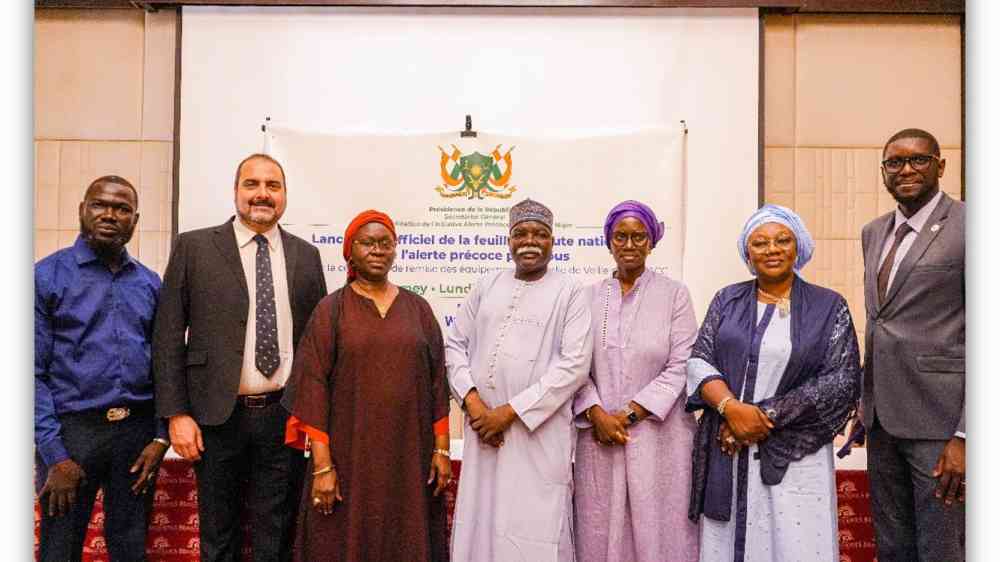
Group photo of participants who attended launch
Developed through a collaborative process led by the Secretary General of the Presidency and National Coordinator of Early Warnings for All, Mossi Salou, the roadmap outlines strategic priorities across the four key pillars of early warning systems. It aims to ensure that every person in Niger is protected by 2027. Aligned with the Sendai Framework and the Sustainable Development Goals (SDGs), the roadmap is based on a participatory approach involving institutions, technical partners, and communities.
“Equipping the COVACC situation room marks a decisive step toward strengthening its technical and operational capacities” , said Madame Kinday Samba, Representative of the UN Resident Coordinator
The launch was followed by the handover of equipment for the Centre Opérationnel de Veille, d’Alerte et de Conduite des Crises (COVACC), which will serve as a central hub for risk information, monitoring, and coordination of early actions. The renovation of the COVACC Situation Room was funded by the Government of Italy and implemented with technical support from UNDRR and the CIMA Foundation, as part of the Africa Multi-Hazard Early Warning and Early Action System (AMHEWAS).
“The equipment handover we are celebrating today marks a decisive step in strengthening Niger’s national early warning system. It is the result of strong cooperation and a shared vision of resilience, fully aligned with the spirit of the global ‘Early Warnings for All’ initiative” Said Roberto Orlando, the Ambassador of Italy in Niger
The Situation Room, which has long served as a central node for crisis monitoring and coordination, was equipped with updated information technology systems and modern office furnishings. These enhancements are part of a broader effort to strengthen national infrastructure for early warning and early action.
“Regular early warning and early action simulations help engage stakeholders, uncover system gaps, and strengthen our ability to protect lives and livelihoods” Said Mariane Diop Kane, Programme Manager of the WMO regional office for Africa.
To further operationalize the roadmap and test the communication flow of COVACC, a Tabletop Exercise was conducted on 14 and 15 October in the situation room. Organized with support from the CIMA Research Foundation and the Italian Red Cross, the exercise brought together national actors to test procedures and strengthen coordination mechanisms for early warning and early action.
“The simulation exercise highlighted the importance of coordination and planning as key factors for the effectiveness of early warning systems and ensuring that early actions are timely and impactful. It is a tool that helps national actors—from meteorological services to disaster managers—build the confidence and clarity needed to act before a crisis unfolds”, Marco Massabo, of the UNDRR Africa office
The acceleration of the EW4ALL and the operationalization of the situation room represent a significant advancement in Niger’s disaster preparedness architecture. As the country continues to face complex climate and hydrometeorological risks, these efforts underscore the importance of proactive, inclusive, and coordinated approaches to risk reduction.